Showing posts with label entertainment. Show all posts

Friday, November 14, 2008

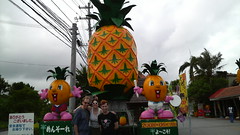
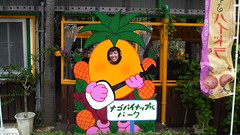
Nago's Pineapple Park!


Back in May we had some guests visit from overseas. We took them to the best place we could think of: Nago's Pineapple Park. Classic.

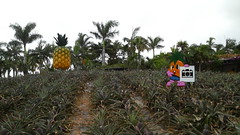
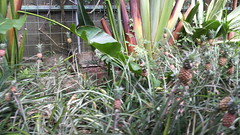
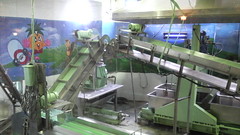
You get there and can take an electric golf cart from the future which drives itself around a field of pineapples while you are guided by "Pineapple herself" telling you interesting things about pineapples.

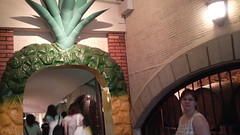
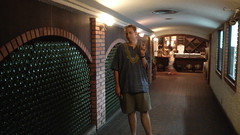
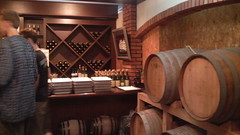
Then you get bombarded with pineapple products. The wine ain't all bad, but this is something you want to share with a lot of people so that you only have to drink a little. The best was the pineapple white chocolate.

Tuesday, October 28, 2008

Being Homeless in Japan: Netcafes, video parlors

I've been writing a lot at my other blog, KudzuKongzi, lately and noticed that I've been writing a little about Japan as well as the other things I'm concerned with at that blog.

As I've written, Japan's homeless population is a little hard to see in part because they're not faced with only sleeping outside - some may also be net cafe refugees.

Another possibility is that those with minimal family ties in Japan and some amount of savings are taking their money to Southeast Asia where the cost of living is lower and their pensions would go further.

All of this is to say that Labor as practiced in Japan is different from what I'm used to in the U.S. (which is to say, in the U.S. organized labor is a lame duck movement now).

Today, the Japan Times offers a nice explanation about netcafes, 24 hour karaoke boxes, and video parlors.

Tuesday, August 19, 2008

Japanese Surfers

There's a scene in Lost in Translation where the character played by Bill Murray is at a party in Tokyo and he's just been told that his host likes to surf, "You surf?" That's how I felt too. I mean, surfing is, of course, really only done in a few places: Hawai`i, Australia, maybe Costa Rica, and then maybe Florida; I don't know. My understanding is that surfing only exists in these few places.

Then I moved to Okinawa and noticed that the locals really like surfing-related stuff. I figured it was due to being in a sub-tropical environment. But then, while in Kyoto, I was told that the owner of our guest house met many Japanese surfers in Bali and these surfers had begun their careers in Okinawa.

But whenever I went to the places where I thought I was told there was surfing I saw only placid ocean.

Then a tropical storm was in the region and the surf was up:


Obon=Eisa

So last week was Obon, like a Japanese Dia De Los Muertos, where the spirits of our ancestors return to us and we offer them food and drink and entertainment.

The offerings go on the family altar, usually some fruit and some rice (this is when you put your chopsticks in the rice sticking up), a glass of water and/or some sake (or awamori in our case).

The entertainment?

Eisa, of course.

We live in Okinawa City, which boasts the best Eisa teams in the country; so each section of the city (Goya, Takahara, Awase, etc.) has a team that goes through the neighboroods playing during Obon.

I was working on the last blog when I heard something, I opened the window and this is what I saw:

I grabbed my wife, who was recording another gorgeous song, and we ran downstairs to find the dancers. And what do you know? They came to us!


These teams rely on the patronage of the neighborhoods, so they will come around with a collections box. We live next to a conbini (convenience store) so we bought them a 6-pack of beer and a few liters of water and gave them Y1000 (we're not sure what we're supposed to give so this seemed to cover all the bases).

So, what happens when two Eisa teams meet while doing the rounds? Well, they have to battle, of course.

The two teams will face off where both teams have to try to maintain the rhythm (because although the songs are the same name, each group has a slight variation of the traditionals). If someone on your team gets off beat you lose and your whole team has to get out of the way and let the others through. To determine this a crowd is really necessary and so the teams really try hard to avoid heavily trafficked areas unless they think that they are rock-solid.

We went to the Goya neighborhood (near Koza Music Town) because we heard that the two best teams in Okinawa, Goya and Senda (spelling?), have a tradition on the last night of Obon of squaring off. On the way we saw these folks:

Wednesday, August 6, 2008

Yonabaru Rope Pull (Best Day Ever, 2.0)

So, we went down to Yonabaru to witness the 400 year old tradition of an all-city tug of war. I really wanted to see the big rope (that takes a year to make) and just take some pictures, maybe have a beer and that would be it, really. But I was wrong. It was much more than that.


First off, any where I go I will be singled-out and subsequently press-ganged into the affair. That's what I get for being 6'6" and so gaijin. (There's this one guy that renounced his American citizenship and has been writing editorials for years now in the Japanese newspapers about how unfairly he's treated in Japan for not being Japanese (looking). But, maybe I've been here for too short a time, I always feel welcome wherever I go in Okinawa and I can barely say, "my name is Paul, sorry my Japanese is so poor.") But I've digressed....

Yeah, just as I'm watching the guy giving the instructions on how to do this whole tug o' war thing (I had assumed this was a practiced team I was looking at), then I'm told that I need to put on this hachimaki (head band) and go pick up the rope for the parade through town.

I felt bad because the guy they paired me with was nearly a foot shorter than I and so he really couldn't carry the rope with me. There I am in the hot, hot sun in this procession with this enormous rope. The rope's so big that there are people standing on it, dressed in ancient ceremonial garb. All I can think is, "great, this guy's gonna get killed 'cause I drop the rope or I'm making the rope tilt too much." Meanwhile there are all these photographers and tourists coming up and taking pictures of this giant white guy carrying the rope being followed by a much smaller, slightly embarrassed Okinawan.

We get there and I'm freaked out: there are hundreds of people there waiting around and I know that we are to drop the rope by dropping the heavy logs that we've had propped on our shoulders to carry this enormous rope. I know that I have to be careful because they are going to throw the logs backwards (toward me) and then we are to start pulling as quickly and as hard as we can.

Somehow they are able (I still don't understand even though I was right there in the front) to thread the two loops together and then, completely by surprise to me, they start tossing the logs over their shoulders. I'm wearing flip flops and there are really big logs being thrown at me and I'm being bumrushed by the villagers as we being this all city tug o' war. I'm sorry there are no photos or videos of this singular experience, I am happy to report that I was not injured nor did I lose my flip flops. We won the first one, I didn't realize there would be a second one (including picking up the rope and threading them together again - even getting the people back up there on the rope!) and so the second one I was wiped out. But it's good because both sides got to win.

Then the second competition really gets going. Each side has a couple of standards on long poles with flowers. The musicians and dancers get everyone all frenzied up and the two sides see who can endure hoisting their standard up the longest. Crazy site.


At the end everyone takes a bit of the rope and puts it up at home or their business for goodluck for the next year.

We got some waters and drove to the 10,000 Eisa Dancers Parade in nearby Naha and that was pretty awesome. Then we went to an Okinawan restaurant and we ate the yummies like goya champaru (stirfried bitter melon with tofu) and mimiga (the skin of pig's ears), and listened to a guy play sanshin and sing the Okinawan standards, like "Haisai Ojisan (Hey Uncle)" and "Shima No Uta (Island Music)" and then we topped it off with my new favorite desert - Okinawan Zenzai, but that's another blog posting in itself. Before returning to our homes we made a night time visit to Shuri Jo, the ancient capital of the Ryukyu Kingdom. It was a beautiful site, all lit up at night.

EISA

So, my wife and I and some folks from the lab are participating in an EISA team and we've been practicing for about a month or so... and it rules.

This weekend we went down to (Yonabaru first, but that's the very next blog) Naha to see the end of the 10,000 Eisa dancers parade.

Eisa seems to have derived its name from a Buddhist chant and is celebrated at the end of the Obon festival as a "one last hurrah" for the ancestors. More at wikipedia.

So the original Eisa dances would have looked something like this:

This team is from Uruma City, where we work.

Okinawa has, over the last century, been developing a more and more energetic dance:


The central region of Okinawa Honto (the main Island) is really renowned for their Eisa teams, and so I feel really honored to represent Okinawa City in the Zento (All-Island) Eisa Festival at the end of August.

Typically the Eisa team will have the sanshin players and singers, big drummers (that's what I'm practicing), the smaller drums, dancers (female and male dances are slightly different), and then a clown-like character that whips everyone into a frenzy. We feel fortunate to be able to participate as usually women are not allowed to play drums and this is really more of a young man's event - oh, and usually no gaijin.

Where we practice is in an old folk's home and I really enjoy getting to practice in front of them because they get all jazzed up and start clapping and singing and I really feel like I'm participating in a deeper human community. I feel honored to welcome their ancestors for one last dance until they come next year. Even more profoundly, sometimes, I feel trusted, a deep trust that is easy to overlook maybe. Some of these folks can't leave their rooms, so they sit up in their beds and they dance and sing and clap. Maybe they will be the ancestors that will come next year during Obon. On the opposite of the spectrum, though are these little kids running around, also practicing these dances and the cycle is just really moving. That's when I feel the strongest need to show my ki-ai that's what all the shouting is about: it's the bellowing of the living, it's a connecting of the heart and the body and mind in an affirmative SAH and I feel so much more alive and grateful for that gift.

In my confucian studies I've come to understand that truth means something different, perhaps more, in a confucian world. What is true is behaving in a way that is true to those who have come before you (those you learn the Eisa dance from) and behaving in a way that can be trusted by those to come (the kids who watch us and practice what we do). And these practices really deeply resonate with me on this level, I feel like this is the most concrete expression of that definition of performative truth; and I feel more convinced that this is the notion of truth that more people should come to know and express.

Thursday, July 10, 2008

Okinawan Microcosmos

I loved the film Microcosmos and so inspired I took my handy 携帯電話 (cell phone, FOMA P905i) which includes a video camera and I went to some beaches. Here's one of a snail:


And here are some following crabs:


Wednesday, July 2, 2008

Bull Fight!

Okinawa is the bull fighting capital of Japan. Who knew? It's not like in Europe, with matadors bleeding the bull to death. Here it's more like sumo wrestling (they even purify the ring with thrown rice), or maybe more like bull arm wrestling.
Here's the beginning of the first match:

So, basically, the bulls are brought into the ring, and brought to face the other bull and then they should lock horns and start to wrasslin' and for the most part that's what happened. Although in this clip all that happened was the other bull got too afraid and was led out of the ring.

But, in the third round one of the handlers lost control of the bull and it was gored by its opponent and that was pretty sad to see happen. The bulls are for the most part spoiled rotten by their owners and so I'm sure the bull will be fine, but it was hard not to feel a little bad for him, 'cause I'm sure that it hurts like hell.

Haari in Onna-son


So, about 2,500 years ago in China there began this festival of racing boats across a river. This has become part of the annual Summer Harvest rituals of East Asia since antiquity. The tradition comes to Okinawa by way of China, with whom the Okinawans have strongly identified over centuries of trade, but that's another post.

The point is: Every year on the Lunar calendar 5/5, East Asia celebrates this festival. In Okinawa they call it a Haari, others call it Matsuri, I call it fun.
Before the race can begin the village assembles at the village shrine (where their ancestors dwell) and ask for them to join in the celebration, then they play drums and walk to the harbor's kami (something like a spirit) shrine and ask for favorable conditions and their influence to get a really good race going. Then a costumed group goes out into the water to show how its done:

Our Institute is currently building an amazing facility in Onna Village and to be good neighbors we entered two teams (one boys and one girls) for the race. This race is not so much about having a bunch of strong folks as much as having a tightly synchronized group.

The men did really well, but there were some really great mens teams out there. The women's team did even better than the men's but, were just 4 seconds short of the finals.
We didn't win the cup (made of Ryukyu Glass, of course) filled with Orion beer. But we did win two gorgeous fish, and we promptly ate them as sashimi and in a soup at the after party.

Thursday, May 29, 2008

Record Shopping in Okinawa City

This is a special post. My old friend, Alex, asked me if I would talk a bit about record shopping here Okinawa and this turned out to be one of my favorite things to do for this blog. So, please, if you are curious about something, like getting groceries, or driving, please don't hesitate to put me on an investigative report!

Okinawa City is the music capital of Okinawa. Recently, Okinawa has become the fertile birthing grounds of many of Japan's top pop performers. Since the 1970's Koza has been at the heart of the Okinawan music scene. So, I went down to Park Avenue Arcade in Koza to do a bit of record shopping.

First off, Japan has the second largest media industry in the world, after Hollywood. So, there's a lot to choose from. And, it's all in Japanese. Which is tough if you don't know how to read Japanese and don't know who plays what kind of music.

Fortunately for you, Tsutaya (which is like Japan's Blockbuster Video) has an extensive music rental section. That's right, you can rent all the cd's you want. Right next to the cash register where you rent the discs are a big ol' pile of cd-rw's. I've yet to rent a cd, but this will be my preferable manner in which to introduce myself.

But, back to Koza.

So, while my wife was away for a week in New Zealand, I decided I'd go check out the record stores one night. My first thought was here:

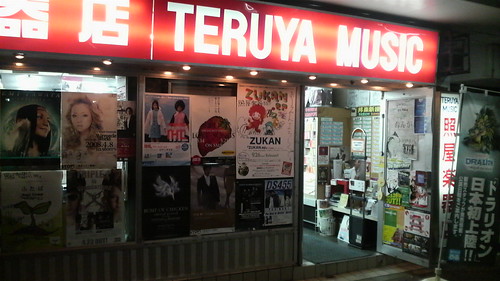
Teruya Music on Park Avenue is awesome. There's a great selection of both Western and Japanese music AND a really great instrument store. You can buy a Buckwheat Zydeco album, something off the Pop Charts here, an accordion, a digital delay, and head on to greatness.

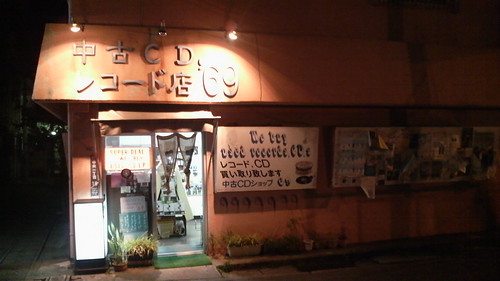
But the best place I found, which I should realize is a no-brainer, is this used cd-shop:

I walked in and the first thing I noticed, was that there were tons of records, not just cds. Probably equal amounts of both. Then I noticed that there was this incredible noise playing. Literally, it was this crazy, droney, loopy stuff. I thought, "Sweet, lots of records, odd music playing, this is gonna be like visiting Matt Benard at the CD Warehouse."

Except Matt spoke my language and we were old room mates. Eventually I was able to ask who it was that was playing, Jim O'rourke (whom I'd only just recently seen when I was looking at the Tenorion youtube clips here and here). That's when I started to get really excited because I saw that they had a copy of his Tzadik (a record label I like very much because of it's "avante-guard stable) release. Then I saw a large collection of Smog's stuff on Drag City Records. Then they started playing this old 45 from Trojan Records (an old school reggae label from the 60s).

I was really floored because this is a used cd shop. These were used cd's. The only Westerners near here other than me and the folks from work are the guys on base (the street parallel to Park Avenue is Gate 2 street that takes you onto Kadena Airbase). In fact, walking around Koza I saw this graffiti that had been intended for the guys on base:

(there are a lot of rapes and bad things being visited on the Okinawans in this area by our service members, and I will address this later).

So, who's buying these cd's and then selling them? I'm stoked to meet them.

What did I buy? Because I'm curious to know more about Jim O'rourke, I get an album with and Thurston Moore (of Sonic Youth) on it. They put together a trio with Mats Gustafsson called the Diskaholics Trio. Click here for more information and to have a listen.
Ryukyu Mura

My co-workers and I went to Ryukyu Mura, which is like a traditional Okinawan Village Themepark. Before being called Okinawa by the Japanese, these islands were called Ryukyu. They were an independent, but poor, kingdom which had its golden age a couple hundred years ago when it was trading freely with China, Korea, Japan, and most of South East Asia. The Japanese conquered Okinawa in the late 19th century and has been slowly eliminating the indigenous culture since then. This village presents a Disney-fied version of what is "Traditional Ryukyuan" living. That said, I highly recommend visiting here, because it's a beautiful park and it's a lot of fun. Especially when they start doing the traditional dances, etc.

The Okinawans don't think of themselves as Japanese, they have a very unique culture that is a blend of indigenous ways of being and heavy influences from both Japan and China. Champuru, mixed, culture. Here you can see the influence of Chinese dragon dances, brought to Okinawa you get something a little different:

When the Japanese conquered the Ryukyus, they forcibly disarmed the population. Prior to this, there had been Okinawan samurai-warrior-types. From this the Okinawans developed the martial art system, Karate, which means "empty hand." In order to teach this deadly art, the Okinawans had to find ways to make it seem like they weren't doing anything particularly lethal, like dancing. If you watch in these videos carefully you will see that these dances are also very much like the movements that you learn in karate:


Here is a bit of the Eisa dance, which is pretty rousing:


No party is done in Okinawa until everyone dances as a group. This is when the really giant gaijin (not-Japanese), me, was picked out of the crowd and had to dance with everyone:

Tuesday, March 25, 2008

Southeast Botanical Gardens

The Southeast Botanical Gardens in Chibana are great. Really great. It's very cheap (about 1,000 yen, but they give you 500 yen in credit at the gift shop), and it has some really neat things to see:

like this cactus-y tree (?)

Okinawa has gorgeous flowers and lots of orchids (which you note immediately after you leave the airplane in Naha).
Here's something called a Jade Plant


There are so many gorgeous things to see at this place that I kinda gave up and just started taking pictures of things that were of interest to me like these guys:

On the left is the bottle palm, I don't know what that is on the right. In both is some kind of tropical mistletoe.


These two above were in the Enchanted Forest section.

This has to be one of my favorite signs (next to the sign at Naha Airport that states puddings are not allowed):

But the real highlight has to be the carp. They're disgusting.

So I took several videos:

You can feed them, there's a vending machine (of course) full of fish food and it's gotta be the best 100 yen you can spend.
Here's me gettin' more riled up:

and here is their bizarre crescendo:


The website for the Southeast Botanical Gardens:
http://www.sebg.co.jp/e/

Cultural Differences

We went to Katsuen Castle Remains in Uruma City. Katsuren is a World Heritage designated by the U.N. and it's a beautiful place. The castle was built in the 12th and 13th centuries and was the home to the great Amawari... you gotta go there, it's free and you can get brochures in English if you so desire.

Here's a picture as we begin the ascent:

It's pretty steep walking up there and as you can see from above, it's a flat drop on the side.

When I got up there I was really struck by two things:
1) Okinawa's gorgeous!
2) there's nothing keeping me from being blown off this castle!

Here's what I mean:

This is the Castle Wall, it's at me knees, and from this picture it's hard to tell, but there's a straight drop just three feet in front of me (refer to the first picture in this series).

Maybe this will clarify what I mean:

The kid is standing at the edge of the Castle Wall and just a foot away from his feet is a significant drop.

In the U.S. this would never happen. I guess we're simply too stupid as a people to know better...I'm not really sure why American society is such a litigious one. Maybe it's the lack of Nationalized/Socialized Healthcare, I dunno. But I do know that this also wouldn't happen in the U.S. because we're so eager to enter lawsuits:

This is a chainsaw plant, I took this photo at the Southeast Botanical Gardens. It's just laying there, waiting for you.

Of course, I am not saying that things should be different here in Japan. I am saying that it's interesting how our two societies are able to function so differently. I'm glad to know it's possible.

Sunday, March 16, 2008

St. Patrick's Day in Koza


Who knew that there was a St. Patrick's Day Parade in Koza, Okinawa City? There sure is. I missed the parade but did get to stroll around the Park Avenue area. Koza is the music capital of Okinawa and what says Erin go Braugh more than crumping (a highly-stylized street dance from the West Coast of the US)?


Not only is there a parade, but there's live music all day and night and a little flea market where I saw this: